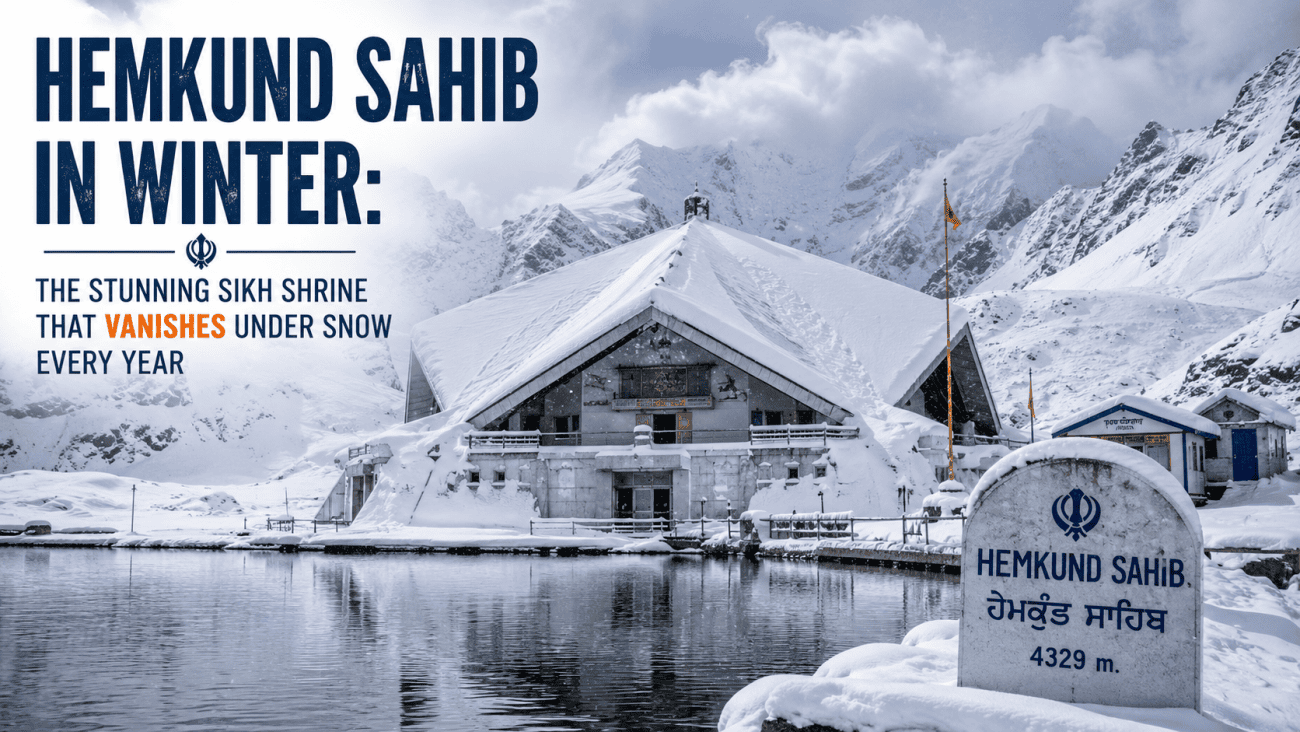
Hemkund Sahib in Winter: The Stunning Sikh Shrine That Vanishes Under Snow Every Year
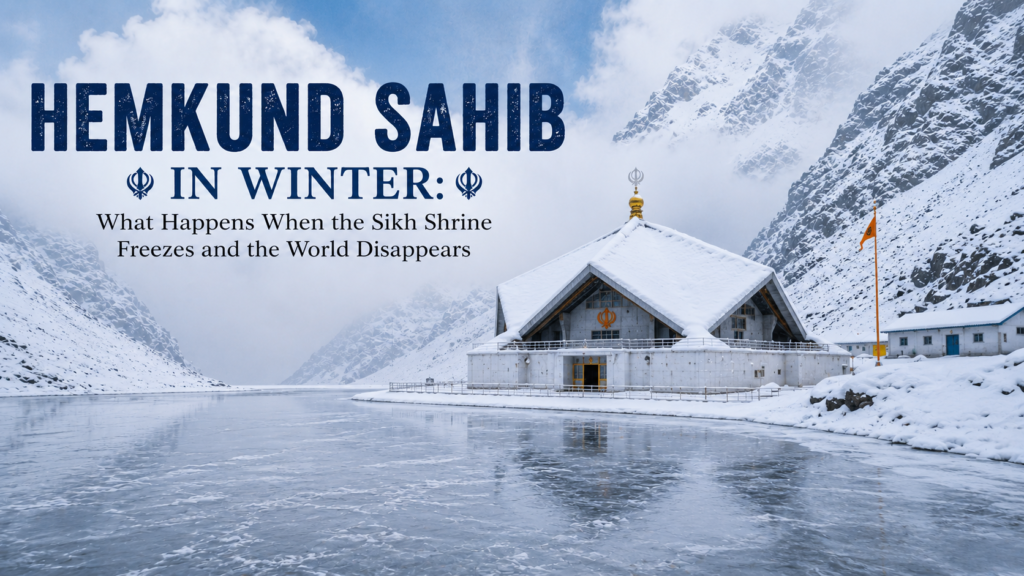
The last pilgrim down the trail doesn’t look back. He can’t — the wind at 15,200 feet won’t let him. Behind him, the gurdwara gates swing shut with a sound that nobody will hear again for six months. The langar fires go cold. The prayer books are wrapped in cloth. And then Hemkund Sahib does something extraordinary.
It vanishes.
Not metaphorically. The shrine at Hemkund Sahib in winter genuinely disappears — buried under fifteen, sometimes twenty feet of Himalayan snow, cut off from every road, trail, and human voice on earth. The glacial lake freezes solid. The seven surrounding peaks become a wall of white nothing. And one of the most important Sikh pilgrimage sites on the planet enters a silence so deep it borders on the sacred.
I’ve visited Hemkund Sahib twice during the summer pilgrimage season, and both times the question that haunted me wasn’t about the climb or the altitude or the freezing dip in the lake. It was this: what happens here when nobody’s watching?
This is the story of that disappearance.
The Shrine That Exists Only Half the Year
Most people know Hemkund Sahib as a summer destination — a gruelling 13 km trek from Govindghat (now shortened to about 9 km with the motorable road to Pulna), ending at a turquoise glacial lake cradled by seven peaks called the Sapt Sring. Every year between late May and early October, over one lakh pilgrims make the climb to pay respects at the gurdwara dedicated to Guru Gobind Singh Ji, the tenth Sikh Guru.
But here’s the thing most travel articles won’t tell you: Hemkund Sahib is not a year-round shrine. It was never designed to be.
The Sikh tradition is remarkably practical about this. The Guru Granth Sahib — the living scripture that sits at the heart of every gurdwara — is physically carried down the mountain before winter sets in. It doesn’t stay to be frozen. It travels with the people. The ardas (closing prayer) is offered, the locks click shut, and the building is left to the mountains.
There’s a theological elegance to this that I find deeply moving. God doesn’t need a roof. Faith doesn’t require a building. And the Himalayas were here long before any of us arrived.
If you’re planning a visit during the open season, our Hemkund Sahib trek guide covers everything from permits to packing lists.
What Actually Happens When Hemkund Sahib Freezes Shut
Let’s get specific. Because the transformation of this site from a bustling pilgrimage hub to a frozen, abandoned wilderness is one of the most dramatic seasonal shifts of any religious site in the world.
Late September to mid-October: The closing date isn’t fixed. The SGPC and local gurdwara management committee monitor weather reports, usually making the call when daytime temperatures start consistently dropping below freezing and the first significant snowfall hits. In recent years, the closing has shifted slightly later — a climate trend we’ll get to.
The final day: Last prayers. The Guru Granth Sahib is reverently placed in a decorated palki (palanquin) and begins the descent — first to Ghangaria, then often continuing to Joshimath or a designated winter gurdwara. Sewadars (volunteer caretakers) do a final sweep of the complex. Solar panels are disconnected or covered. Water pipes are drained. Doors are bolted.
Then the snow arrives.
Temperature at Hemkund Sahib in winter routinely drops to -25°C to -40°C with wind chill. The lake — where summer pilgrims gingerly dip their feet in water barely above freezing — becomes a solid block of ice buried under accumulating snowfall. By January, the site is unrecognizable. No trail markers. No bridges. The stone steps that thousands climb in summer are metres beneath the surface.
The Alaknanda river valley below still carries meltwater, but up here? Nothing moves. The waterfall that feeds the lake freezes mid-flow. The bugyals (alpine meadows) that explode with wildflowers in July — including the adjacent Valley of Flowers — become featureless white plains.
And the gurdwara itself? It stands. Barely. The freeze-thaw cycles hammer the stone and concrete structure every winter. Cracks widen. Foundations shift. By the time the first recon team arrives in April or May, they often find damage that needs weeks of repair before pilgrims can return.
The People Who Walk Away — And What They Leave Behind
I once asked a granthi (scripture reader) at Ghangaria what it feels like to close the shrine for winter. He paused for a long time.
“You don’t leave God behind. God comes with you. What you leave behind is a building — and the mountains will take care of it better than we can.”
That stayed with me.
The descent from Hemkund Sahib to Ghangaria is hard enough in good weather. Doing it in October, with fresh snow on the trail and daylight fading fast, requires real grit. The last sewadars down are often local villagers — Bhotia communities from the Mana and Niti valleys who’ve lived at altitude for generations and understand winter in their bones.
Ghangaria itself empties out. This tiny settlement at 3,050 metres — the last stop before both Hemkund Sahib and the Valley of Flowers — goes from hosting thousands of pilgrims daily to hosting maybe a handful of locals. Tent colonies collapse. Dhabas board up. The helicopter service to Govindghat shuts down.
And then the Indo-Tibetan Border Police (ITBP) continues its patrols. Because here’s the geopolitical detail that surprises most people: Hemkund Sahib sits in a militarily sensitive zone. The border with China (Tibet) isn’t far as the crow flies. Soldiers move through this landscape in winter — probably the only humans who witness the frozen shrine in its abandoned state. I’d love to hear what that feels like. Nobody’s ever really written about it.
The Frozen Lake, the Silent Peaks, and the Wildlife That Returns
Here’s a detail that might change how you think about Hemkund Sahib entirely. When the pilgrims leave, the wildlife comes back.
The Chamoli district is confirmed snow leopard territory. Camera traps in the broader Nanda Devi Biosphere Reserve — a UNESCO site that encompasses the Hemkund area — have photographed these ghost cats moving through terrain that looks almost identical to the frozen Hemkund basin. Himalayan tahr, musk deer, and the spectacular Himalayan monal pheasant also inhabit these slopes.
In summer, they avoid the trail. Thousands of humans, blaring kirtan from portable speakers, langar smoke, and general pilgrimage chaos drives them to quieter valleys. But in winter? The mountains belong to them again.
The Hemkund lake itself — that surreal turquoise body of water where pilgrims take a ritual dip in July — becomes a flat white disc, indistinguishable from the surrounding snowfield. Scientists studying glacial tarns in the Garhwal Himalayas note that these high-altitude lakes support microbial life even under thick ice. The lake doesn’t die. It just goes quiet.
And the seven peaks of the Sapt Sring, which in summer look like dramatic backdrops for selfies, become a genuine wall — the kind of terrain that avalanches pour off of, the kind of silence that makes your ears ring.
The Climate Change Nobody’s Talking About
Hemkund Sahib in winter isn’t just a curiosity. It’s a climate indicator — and the data is alarming.
The Garhwal Himalaya has seen measurable reductions in snowfall duration and earlier spring melts over the past two decades. Local guides I spoke with during my last visit (2024 season) mentioned that snow at higher elevations seems to arrive later and melt faster than it did even ten years ago. The 2021 Chamoli disaster — a devastating flash flood triggered by a rock and ice avalanche in the Ronti Peak area — killed over 200 people downstream. It was a terrifying reminder that glacial systems in this region are destabilizing.
Joshimath, the road-head town where most Hemkund pilgrims begin their journey, made international headlines in January 2023 when buildings began cracking and sinking due to land subsidence. The town sits on unstable geological material, and the combination of infrastructure development, glacial melt, and seismic activity has made the entire zone fragile.
For Hemkund Sahib specifically, the concern is twofold:
- Trail and infrastructure damage is increasing — bridges wash out more frequently, landslides block the approach to Govindghat, and the gurdwara itself suffers more freeze-thaw damage as temperature swings become more extreme.
- The “frozen silence” period is potentially shortening. If winters become milder, the shrine might be accessible for longer — which sounds like good news but actually threatens the glacial ecosystem that sustains the lake and the surrounding biodiversity.
Our Uttarakhand climate and travel updates page tracks these developments throughout the year.
The Reopening: When the Mountains Let the Pilgrims Back In
Every spring — usually late April or May — a small team pushes back up the trail to assess what winter has done.
This is not a casual stroll. The path is buried under snow in places, bridges may be gone, and the final ascent to 15,200 feet at altitude is genuinely dangerous when conditions are uncertain. The team typically includes gurdwara management volunteers, local porters, and sometimes district administration officials.
What they find determines the reopening date. If the structure is intact and the trail is passable, the Guru Granth Sahib is carried back up — accompanied by prayers, music, and the kind of emotion that’s hard to describe unless you’ve seen it. The first ardas of the season at Hemkund Sahib is a moment of genuine spiritual electricity. People cry. The langar fires are lit for the first time in six months.
The Hemkund Sahib reopening date 2026 is expected to fall around late May, though this depends entirely on weather conditions. The official date is usually announced through Sikh community channels and the Uttarakhand Tourism Development Board.
Within days, the rush begins. Thousands of pilgrims pour into Govindghat, Ghangaria fills with tent-wallahs and chai-sellers, and the trail that was silent and buried for half a year transforms into one of the busiest high-altitude pilgrimage routes in India.
It’s jarring. And beautiful. And completely, wonderfully chaotic.
Should You Ever Try Visiting Hemkund Sahib in Winter?
No. It’s technically not prohibited by law (the area isn’t a restricted zone like parts of the India-China border), but attempting the trek in deep winter is extremely dangerous and, frankly, foolish for anyone without serious high-altitude mountaineering experience. There’s no trail, no rescue infrastructure, no mobile connectivity, avalanche risk is high, and temperatures can kill in hours.
I’ve seen online forums where adventurous types discuss “winter Hemkund attempts.” My honest take? Don’t. The mountains don’t care about your Instagram feed.
That said, there’s a legitimate fascination with the site in its frozen state — and technology is slowly making it possible to experience without risking your life. Satellite imagery, drone footage (when legally obtained), and documentation by ITBP patrols and research teams offer glimpses of what the shrine looks like under snow. Some of these images are genuinely haunting — the gurdwara roof barely visible above a white ocean, the lake a flat grey disc, the peaks lost in cloud.
If you want the spiritual experience of Hemkund Sahib’s winter silence, I’d suggest visiting in late September, during the final week of the pilgrimage season. The crowds thin dramatically. The air already bites. You can feel winter arriving. And when you descend for the last time, you’ll carry the knowledge that the place you just left will soon be gone — buried, silent, waiting.
The Bigger Picture: Shrines That Disappear Across the Himalayas
Hemkund Sahib isn’t alone in this. The Himalayan pilgrimage tradition is full of seasonal sacred geographies — sites that exist for humans only part of the year.
- Kedarnath Temple (3,583m): Closes for roughly six months. The deity is ceremonially moved to Ukhimath for winter worship.
- Yamunotri and Gangotri: Both close around Diwali. The gods “migrate” to lower-altitude winter seats.
- Amarnath Cave: The ice shivling that draws hundreds of thousands of pilgrims melts and reforms annually — a shrine literally defined by seasonal physics.
- Mount Kailash: Never climbed, circumambulated only in summer — sacred absence on a cosmic scale.
What makes Hemkund Sahib unique within this tradition is the Sikh theology of portability. Unlike Hindu temples where the deity itself is considered present in the stone murti, Sikh worship centres on the Guru Granth Sahib — a text, a living word — that travels. The gurdwara is a place of gathering, not a fixed seat of divine presence. When the building empties, nothing sacred is lost.
That’s a radical idea. And standing at the locked gates in October, with the first snow stinging your face, it hits different.
Practical Info: If You’re Planning the Summer Visit
Since you can’t visit in winter — and shouldn’t try — here’s what you need for the open season:
| Detail | Information |
|---|---|
| Altitude | 4,632 metres / 15,200 feet |
| Trek distance | ~13 km from Govindghat (shorter from Pulna via motorable road) |
| Trek difficulty | Moderate to strenuous — steep final 6 km from Ghangaria |
| Best months | June to September |
| Expected reopening 2026 | Opened Now (confirm via official Uttarakhand tourism channels for more details) |
| Accommodation | GMVN guest houses and tented camps at Ghangaria; no accommodation at the shrine itself |
| Registration | Mandatory through the Uttarakhand Char Dham/ Hemkund Sahib yatra portal |
| Nearest railhead | Rishikesh (approx. 275 km to Govindghat by road) — IRCTC booking |
| Nearest airport | Jolly Grant Airport, Dehradun (approx. 295 km) |
Pro tip from experience: Don’t underestimate the Ghangaria-to-Hemkund section. It’s only 6 km but gains roughly 1,000 metres in altitude. The air is thin. The stone steps are steep. I’ve seen fit-looking 30-year-olds gasping at the top. Start early. Carry water. And for the love of everything, don’t skip breakfast — the langar at the top is magnificent, but you need fuel before the climb.
Our complete Govindghat to Hemkund Sahib trek guide has detailed day-by-day planning, altitude charts, and packing essentials.
What Deep Winter at Hemkund Sahib Taught Me (Without Going There)
I’ve never seen Hemkund Sahib in winter. Few have. And honestly, I think that’s the point.
There’s a quiet power in knowing that one of the holiest Sikh sites on earth spends more months buried in silence than it does alive with prayer. That the mountains reclaim it every year. That the lake freezes, the trails vanish, the snow leopards return, and the gurdwara stands there — battered, patient, waiting.
It reframes the summer experience entirely. The next time you’re climbing those final steep steps to the shrine, breathless and cold even in July, remember: in a few weeks, this place will be gone. Not destroyed. Just… absent. Returned to the silence it came from.
And then it’ll come back. As it always does.
Frequently Asked Questions
Is Hemkund Sahib open in winter?
What is the temperature at Hemkund Sahib in winter?
Can you trek to Hemkund Sahib in December or January?
When does Hemkund Sahib reopen in 2026?
Is Hemkund Sahib worth visiting compared to Kedarnath?
How much does a Hemkund Sahib trip cost?
What happens to the Hemkund Sahib gurdwara when it’s covered in snow?
Is the trek to Hemkund Sahib suitable for beginners?
Final Thoughts: The Shrine That Teaches You to Let Go
Every religion has its monuments that claim permanence — temples carved from mountains, cathedrals that took centuries to build, mosques designed to outlast empires. Hemkund Sahib makes the opposite claim.
It says: we are temporary here. The mountain is not.
And somehow, that makes it more sacred. Not less.
If the frozen silence of Hemkund Sahib in winter speaks to you — and if you’ve read this far, I suspect it does — then plan your summer visit for 2026. The shrine is expected to reopen in late May, and early season means thinner crowds, cleaner skies, and the kind of cold mountain light that photographs can’t capture.
Explore more Himalayan pilgrimage routes on uttarakhand.tours — from the Char Dham yatra guide to the lesser-known Madhyamaheshwar trek. Share this article with someone who needs to know this place exists. And start planning.
The mountains are waiting. They always are.
